PoE 2 Currency Guide: What Every Orb Does and How the Currency Exchange Works

In Path of Exile 2, currency orbs are both crafting tools and money: Transmutation, Augmentation, Regal and Exalted Orbs build up items step by step, Chaos and Annulment Orbs swap or remove modifiers, Divine Orbs reroll modifier values, Vaal Orbs corrupt items, and the Exalted and Divine Orbs double as the main trading currencies. You trade stackable currency instantly with other players at the Currency Exchange, run by Finn, Risu and Alva, and you sell gear asynchronously through Ange, who lists your items even while you are offline.
Orb | What it does | Use |
|---|---|---|
Orb of Transmutation | Normal item to Magic, one modifier | Early crafting |
Orb of Augmentation | Adds a second modifier to a Magic item | Early crafting |
Orb of Alchemy | Normal item straight to Rare, four modifiers | Quick rares |
Regal Orb | Magic to Rare, adds one modifier | Crafting base |
Exalted Orb | Adds a new modifier to a Rare | Crafting, everyday trading |
Chaos Orb | Replaces one random modifier on a Rare | Crafting |
Divine Orb | Rerolls the values of existing modifiers | High-value trading |
Orb of Annulment | Removes one random modifier | Expensive crafting |
Vaal Orb | Corrupts an item, unpredictable result | High-risk upgrades |
Mirror of Kalandra | Copies a non-unique item | The rarest item in the game |
Artificer's Orb | Adds a rune socket | Gear upgrades |
Gemcutter's Prism | +5% gem quality, up to 20% | Skill gems |
Glassblower's Bauble | Improves flask quality | Flasks |
Orb of Chance | Normal item may become its Unique, or is destroyed | Gambling |
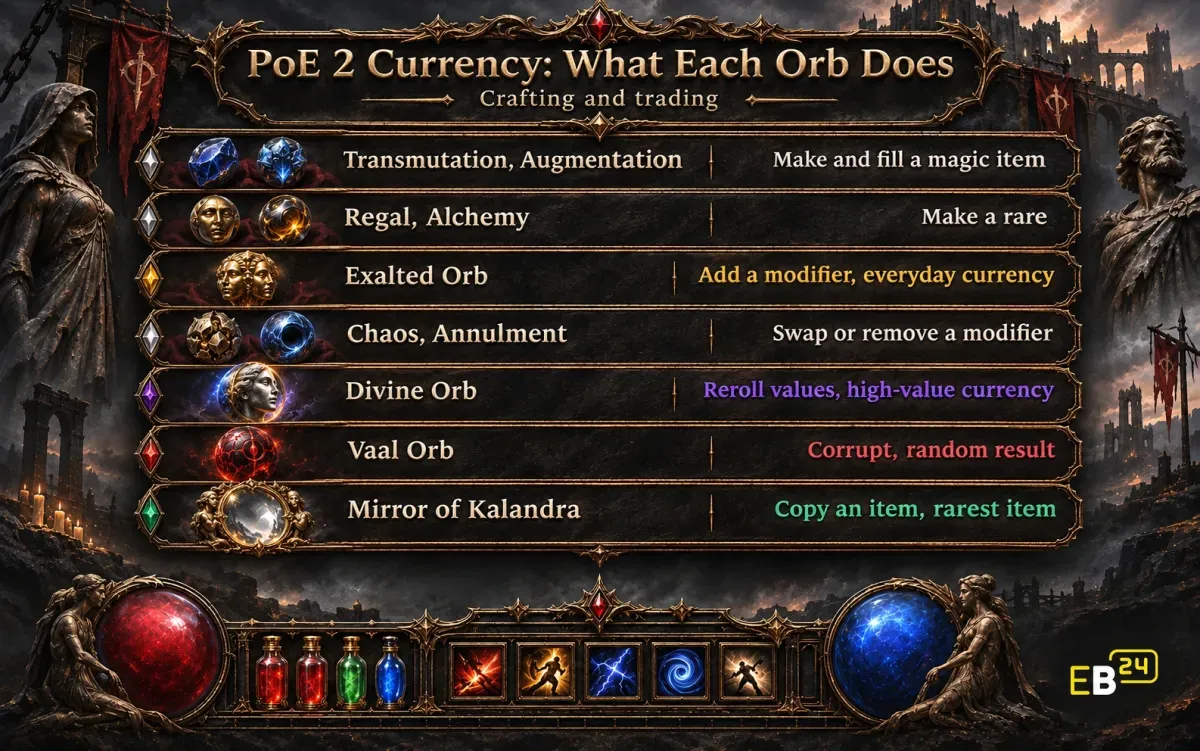
Crafting Orbs in Order
Think of a basic craft as a ladder:
Transmutation turns a white item blue with one modifier.
Augmentation adds a second modifier to the blue item (one prefix and one suffix maximum).
Regal turns the blue item rare and adds a third modifier.
Exalted adds more modifiers, up to six on a rare.
Alchemy skips the ladder and turns a white item straight into a rare with four modifiers. Chaos swaps one modifier for a new one, and Annulment removes one, which helps when a single bad modifier ruins an item.
Transmutation, Regal and Artificer's Orbs also come as shards: ten shards make one orb.
The Money Orbs: Exalted and Divine
Exalted Orbs are the everyday trading currency for decent items.
Divine Orbs reroll modifier values within their range, and they are the standard currency for anything valuable.
The ratio between them moves a lot during a league, from under 100 Exalted per Divine at a league start to several hundred later, so check a live price tracker before big trades. For farming tips, see how to farm Divine Orbs in PoE 2.
Vaal Orbs and Corruption
A Vaal Orb corrupts an item so it can never be modified again. The outcome is random: an enchantment, an extra socket, half the modifiers rerolled, or a unique's values changed. It also works on skill gems. Use Vaal Orbs only on items you can afford to lose.
Quality and Socket Currency
Artificer's Orb: adds a rune socket to weapons and armour (two-handed weapons and body armour up to two, helmets, gloves and boots one).
Gemcutter's Prism: +5% skill gem quality, up to 20%.
Jeweller's Orbs: add sockets to skill gems (Lesser for the third, Greater for the fourth, Perfect for the fifth).
Blacksmith's Whetstone, Arcanist's Etcher, Armourer's Scrap: quality for martial weapons, caster weapons and armour.
Glassblower's Bauble: flask quality.
How the Currency Exchange Works
The Currency Exchange lets you trade stackable currency with other players instantly.
Where: Finn (Act 1, Clearfell Encampment), Risu (Act 2, Ardura Caravan) and Alva (Act 3, Ziggurat Refuge, the endgame and your hideout).
How: pick what you have and what you want, set a ratio (a suggested market rate is shown), and place the order. Placing an order costs Gold based on the size of the trade.
Filled or listed: if a matching order exists it completes at once; otherwise it is listed until someone fills it. Cancelling returns your currency but not the Gold.
What you can trade: currency, Delirium, Breach and Expedition items, fragments, essences, runes, omens, Soul Cores, waystones and more. Not equipment.
Selling Gear: Async Trade With Ange
For weapons and armour, invite Ange (from Kingsmarch, Act 4) to your hideout and list items through "Manage Shop". The items appear on the trade website, and buyers purchase them through Ange's merchant window for a Gold fee, even when you are offline.
New Currency in 1.0
The Conquerors of Wraeclast league adds Forgemarks, Crimson Iron and Blood Vials, used with the Reforging Bench and Runeforging to lock modifiers as Fractured or force specific modifiers. Details in our PoE 2 1.0 crafting guide.
Need Orbs Now?
Crafting eats currency fast. PoE 2 orbs are sold by league and type on our marketplace, delivered by trade with no login needed. Check what your items are worth with the free PoE 2 item value calculator, and if you have currency to spare, you can sell on EB24.
Rather buy than farm? PoE 2 items and ready Path of Exile 2 accounts are on our marketplace.
FAQ
What does a Divine Orb do in PoE 2? It rerolls the numeric values of an item's existing modifiers. It is also the main currency for valuable trades.
What does an Exalted Orb do in PoE 2? It adds a new random modifier to a rare item. It is the everyday trading currency.
What is the most valuable currency in PoE 2? The Mirror of Kalandra, which copies a non-unique item. It is the rarest item in the game.
How does the PoE 2 Currency Exchange work? You set what you have, what you want and a ratio, then pay Gold to place the order. It fills instantly if a match exists.
Can you trade gear on the Currency Exchange? No. Gear is sold through Ange's asynchronous merchant system.
Where is the Currency Exchange in PoE 2? At Finn in Act 1, Risu in Act 2 and Alva in Act 3, the endgame and your hideout.
You might also like