

Top-Up vs Gift Card vs Game Currency: What's the Difference and Which Is Safest?

Every game has its own money. V-Bucks, Riot Points, Valorant Points, Robux, Diamonds, UC, COD Points, gold, coins. And there are at least three completely different ways to get it without going through the in-game store: a direct top-up, a gift card, or buying currency from another player.
They sound interchangeable. They are not. They work differently, suit different games, and carry very different risks. Picking the wrong one is how people end up with a region-locked code they cannot redeem, or a flagged account.
Here is how each one works, and how to choose.
Option 1: Direct Top-Up
What it is: premium currency is credited straight to your account.
How it usually works: for many games, especially mobile titles, a top-up only needs your player ID and server. You do not share your password. The currency lands in your account through the game's own system.
Where it is common: Mobile Legends, Free Fire, PUBG Mobile, and similar games that are built around ID-based top-ups. It is also used for games like Valorant, League of Legends, Fortnite, and others, where the method can differ by game and platform.
Pros:
Premium currency that behaves exactly like currency you bought yourself.
For ID-based games, no password sharing.
Usually fast.
Watch out for:
Region. Top-ups are often tied to a server or region. Make sure it matches yours.
Method. Know whether a top-up needs only your ID, or your login. If a game only needs your ID, never give your password to anyone offering a top-up.
Option 2: Gift Cards and Codes
What it is: a code you redeem yourself, either for a specific game's currency or for a platform wallet like PlayStation, Apple, or Steam.
Pros:
You redeem it yourself. Nobody touches your account.
Works well as a gift.
Platform gift cards are flexible across many games.
Watch out for:
Region locking. This is the most common problem by far. A code bought for one region often will not redeem in another. Always check.
Currency type. A platform wallet card is not the same as a specific game's currency. Check what you are actually getting.
Option 3: Player-Traded Currency
What it is: currency that players earn in game and trade to each other. Think MMO gold, FUT coins in EA Sports FC, Robux transfers, Path of Exile orbs, or in-game money in games like GTA Online.
This is fundamentally different from the first two. Top-ups and gift cards give you premium currency through official channels. Player-traded currency is in-game currency moved between players, which is exactly what many publishers restrict.
Pros:
It is often the only way to get large amounts of tradeable in-game currency quickly.
For some games, like MMOs and FUT, it is the currency that actually buys things.
Watch out for:
Publisher rules. Many games prohibit buying traded currency. Penalties vary from a currency wipe to account action. Know the rules for your game.
Delivery method. Some methods need your login, others do not. Understand which one you are using and what it exposes.
Where you buy. This is the category where scammers operate most. Only buy where payment is protected.
Quick Comparison
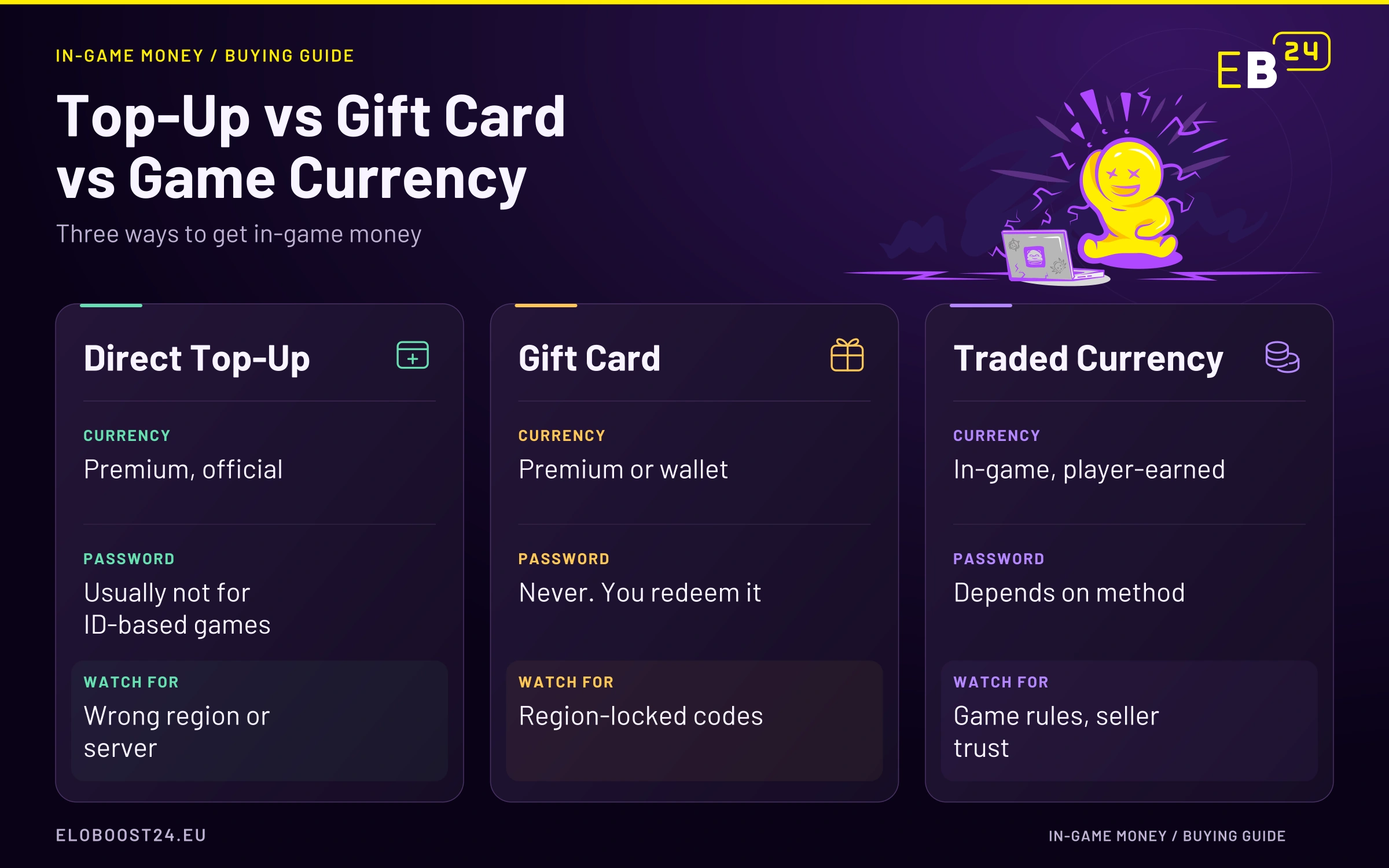
Direct Top-Up | Gift Card | Player-Traded Currency | |
|---|---|---|---|
Currency type | Premium | Premium or platform wallet | In-game |
Who redeems | Credited to your account | You | Delivered by seller |
Password needed? | Usually not for ID-based games | No | Depends on method |
Main risk | Wrong region or server | Region lock | Publisher rules, seller trust |
Best for | Mobile and ID-based games | Gifts, platform wallets | MMOs, FUT, trading economies |
Which One Should You Use?
You play a mobile game with ID top-ups: use a direct top-up.
You are buying for someone else, or want to keep your account completely untouched: use a gift card, and double check the region.
You need tradeable in-game money in an MMO or FUT: that is player-traded currency. Read the rules for your game, and only buy with payment protection.
Safety Rules for All Three
Buy where payment is protected and only released once delivery is confirmed.
Match the region and server before paying.
Never share a password a method does not actually need.
Be suspicious of prices far below everyone else's.
Keep your order record until the currency is safely in your account.
Top-Ups and Currency on EB24
Top-ups and currency on EB24 run through the same protected checkout as the rest of the marketplace, and your first items or currency order gets 5% off. Payment is held after checkout and released to the seller once the order is delivered.
Top-ups: League of Legends Riot Points · Valorant Points · Fortnite V-Bucks · Apex Coins · COD Points · Overwatch Coins · Mobile Legends Diamonds · PUBG Mobile UC · Free Fire Diamonds · Clash of Clans Gems · Clash Royale Gems · Wild Rift Wild Cores · Honkai: Star Rail · Pokemon Go PokéCoins · Robux
Player-traded currency: EA Sports FC Coins · World of Warcraft Gold · WoW Classic Gold · Path of Exile II Orbs · Old School RuneScape Gold · GTA V Money · Arc Raiders Coins · Diablo 4 Gold · Robux
Browse everything on the currency marketplace, or read the how to buy guide first.
FAQ
Is a top-up safer than buying currency from a player? Generally yes. A top-up delivers premium currency through official channels, while player-traded currency is often restricted by publishers.
Do I need to give my password for a top-up? For ID-based games, usually not. Only your player ID and server. Never share a password a method does not require.
Why won't my gift card redeem? The most common reason is a region mismatch. Codes are often locked to the region they were bought for.
Can I get banned for buying game currency? For player-traded currency, it depends on the game's rules, and many prohibit it. Official top-ups and gift cards do not carry that risk in the same way.
You might also like