




How do Valorant placements work? - EB24 explains ranking system

What are the placement games in Valorant and how does the ranking system work? For fans of FPS (first-person shooter) multiplayer games, Valorant offers a ranked match option that pits five players against five opponents. The placement game matches focus on players who've achieved mastery levels with their favorite champions and want to test their might against the rest of Valorant's elite talent pool.
Know About Valorant Competitive Placement Matches
For newcomers, the most common questions asked are "What is a placement game in Valorant?" and "How do placements work in Valorant?" Before you consider jumping into a competitive match in Valorant, you need to understand how the Valorant ranking system works. You also need to learn how the game's Acts factor in as you strive to earn the highest possible in this competitive system.
The way the Valorant competitive placements work calculates all the wins and losses earned by a specific champion who must play five placement matches in the game in a ranked mode so it can establish its individual performance. There are five ranked matches in total. At the start of each new episode, you need to play your champion in all five games to rank in Valorant. As you are on this task, the only way your champion's skill level and tier will improve is by completing all five placement matches to get a rank.
How Does the Valorant Ranking System Work?
How do Valorant placements work? How to play placement games in Valorant is easy enough to follow once you understand how the rank distribution system works. The competitive games formula Riot Games uses for its multiplayer and matchmaking rating modes differs slightly from other multiplayer games that also use a ranking system. Valorant relies on a unique Matchmaking Ratings (MMR) and Rank Ratings (RR) method that ensures players are in a game mode that's fair and precise. The Leaderboards keep out how many placement matches Valorant has tracked for each player who has competed in this ranked mode. It focuses strictly on ratio kills and wins as opposed to how many ranked games for placement in Valorant were played overall.
Valorant Rank Distribution
Currently, players need to play ten unrated matches to unlock competitive mode. From there, you need to complete five placement matches before your champion can rank up. Each placement match determines where you should start in its ranking system. In addition to calculating the wins and losses earned in ranked mode, Valorant also considers your ten previous unrated wins as it determines where your champion ranks.
Valorant Ranks In Order
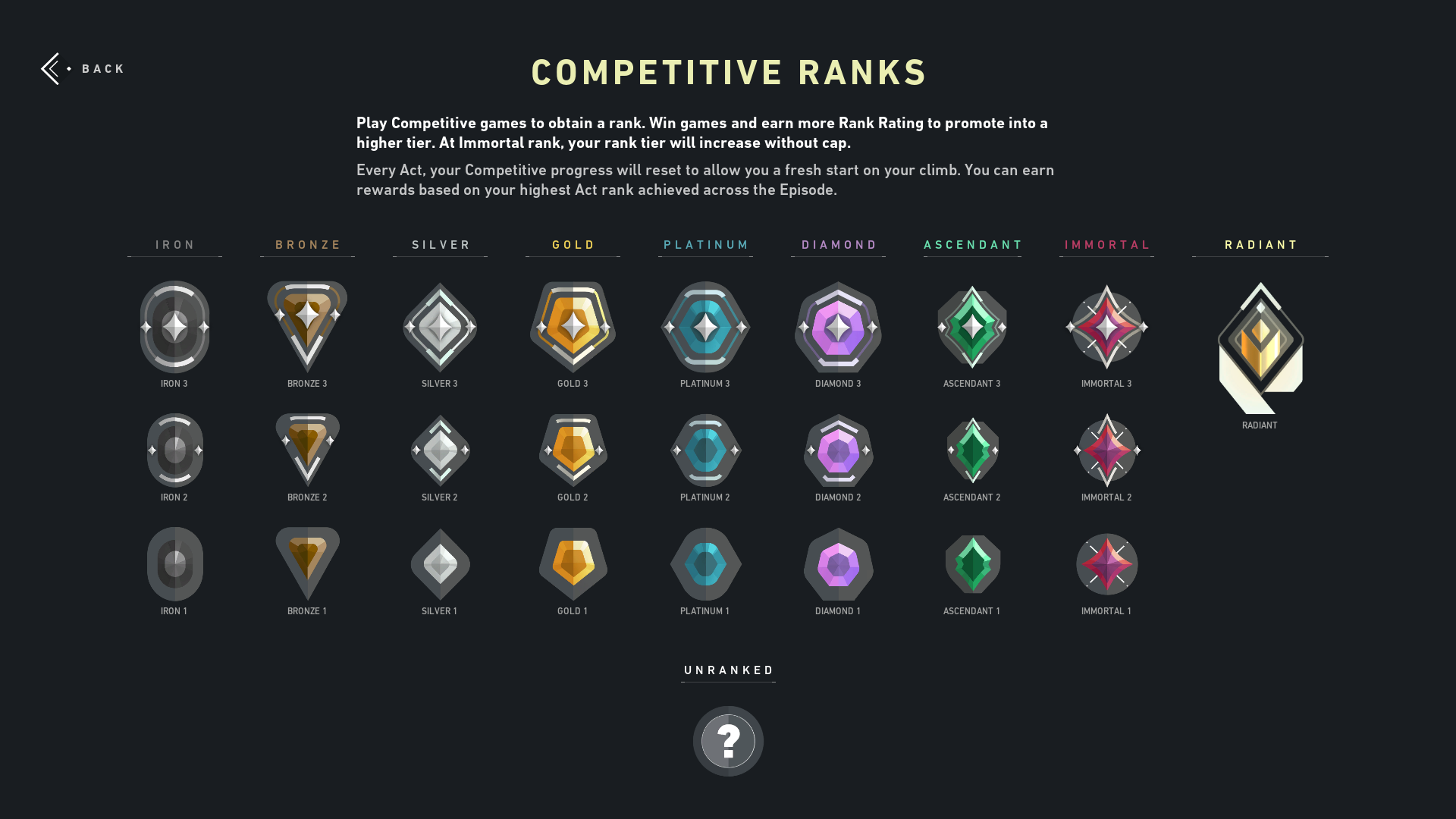
In total, there are nine ranks in the Valorant ranking system. From lowest rank to highest, they are as follows;
- Iron
- Bronze
- Silver
- Gold
- Platinum
- Diamond
- Ascendant
- Immortal
- Radiant
Among the first eight ranks, there are three tiers a player needs to achieve before advancing to a new rank. The highest rank, Radiant, only has one tier. In total, there are twenty-five ranks in Valorant. This doesn't take into consideration the unranked mode.
How To Rank Up In Valorant
For your account level to earn the highest rank you can get, you need to first play 10 unrated matches before earning your initial placement so you can play competitive mode in Valorant. The first rank is Iron. The majority of the players start here. There may be the odd exception where their placement matches might put them at a slightly higher tier level. As each new episode begins, the players need to play five placement matches to get placed. The highest possible placement a champion can earn during Valorant's ranked game mode is Ascendant 1.
Players need one placement match before receiving a rank in Act 2 or Act 3 of a new episode. The ranks won't drop at the beginning of each Act but can drop if the placement match encounters a bad experience. There is also the possibility of skipping ranks and tiers in competitive mode. These are determined by your matchmaking rating (MMR), performance, and kills (frags) in a ranked play match. To achieve this, a player has to be consistent with large win streaks and earn some MVPs. To rank up, you need a 100 Rank Rating per act.
Each time you advance from a lower rank to a higher one, you start with 50 RR going into a new episode, and it's Act 1. Act 2 and Act 3 allow a player to start with a minimum of 10 RR. Once you reach Immoral 2 or higher, the only way you can be promoted is to meet the specific amount assigned by the game's regional settings.
With Riot Games, players also have access to Episode 2 and its Regional Leaderboard. This board also includes your rank, rating, and personal information. If you'd rather be anonymous while competing, you can also change the personal info to read "Special Agent" instead. However, with regional leaderboards, you need to play at least fifty competitive games before your rank appears on them.
How To Get To Immortal and Radiant Rank In Valorant
The highest rank you can get in placements Valorant is Radiant. This tier level is reserved for the best of the best. Before getting there, you need to rank up to Immortal. Both of these ranks require lots of patience and dedication. These are achievable as long as you fully understand how Valorant's placement matches and ranking system works. The best way to achieve this is to log in regularly so you avoid running into ranking decay issues.
Achieving ranks as high as these requires looking into your match history to learn what you're doing right and what you're doing wrong. When visiting the game's main dashboard, select the Career tab at the top of the screen and check out the information based on your last ten matches. You can also compare notes between your performance record and ones belonging to others who've competed in the same matches as you. This is one good way to select a game and go over the details.
How To Improve and Maintain Highest Rank Mode In Valorant
Today, most online multiplayer FPS games have a ranking decay mechanism. When players spend too much time away, their rank may experience a decline by the time they come back. With Valorant, the ranking decay isn't quite as severe. However, if you do spend too much time away to play Valorant, you may have to work your way so you can reinstate your spot on the game's ranked ladder. A placement game will help reestablish your current rank and skill level.
Should you spend an extended time away when it comes to Valorant, completing a placement game is a good way to get back into competitive mode. This will help, especially if you need to either achieve or maintain your Immortal rank or Radiant rank. When it comes to regional leaderboards, should you spend at least a couple of weeks away, you will experience a gradual decline in your ranking system in Valorant. You will need to play as many ranked competitive matches as possible, if you wish to regain what you've lost.
Matchmaking Rating (MMR) System Explained
A player's matchmaking rating (MMR) is an internal system Valorant uses to determine your rank and placement in the game's competitive ranking mechanics. This important feature features numbers you'll never have access to but they're used as a means to pair you up with other players while in competitive mode. Riot Games uses its MMR system to determine how many wins and kills you've achieved as a player based on your performance. It doesn't factor in how many games you've played.
For instance, a player who has played 100 games but only has 50 wins will rank lower than a player who only played 50 games but has earned 40 wins. How effective a player has been in their matches also plays a factor. You can have two players share the same stats as 50 games and 40 wins but if one has scored a higher amount of kills than the other, the one with the more kills will rank higher.
The matchmaking rating system differs from the rank rating system in Valorant. MMR focuses on the game match while RR looks at your performance rank while in competitive mode. The more you win and the better you perform, the more points you earn.
Rank Rating (RR) System Explained
A player's rank rating features the number of points you gain after each match completed in competitive mode. You earn these rank rating points based on competition wins and overall performance in the match, especially in lower tiers. When advancing to the next tier, a minimum of 100 RR points is required. The allocation of these points differs from one game to the next.
A win will earn anywhere from ten to fifty RR points. For Diamond ranks and above, it's 5+ RR. For losses, there is a minus anywhere between zero to thirty RR points. A 50 RR max drop occurs for players who are ranked Diamond and higher. As for matches determined as a draw, 20 RR points are awarded for ranks between Iron and Diamond. These are determined by the player's performance level as well.
A player can become demoted to the previous tier if no RR points have been earned in the game. If you wish to avoid getting demoted, Valorant has "demotion protection" for players who won't go below 70 RR for the newly demoted rank. To get back to ascend back to the previous rank, you'll need 30 RR points to do so. Need help with Valorant unrated matches or Valorant placement matches? Check our Valorant wins boosting service!
Need To Play Smarter, Not Harder In Competitive Mode
The best players in Valorant base their tactics on exercising sound strategy. This requires dedication to avoid making mistakes that hinder a player's gaming performance. Riot Games and Valorant's ranking system couldn't care less how many games you've played. It cares more about your win ratio and the skills you exercise during your matches. The key is to make the most out of your gaming experience by evaluating what the other players are doing. If you want to rank among the best, learn from the best. Some of the best players in Valorant have resorted to utilizing coaches to help them achieve certain goals they've set out for themselves such as ascending through the different ranks on their way to the top. We can help you with Valorant account boosting as well as elo boosting.
You might also like