




What is a VPN in Gaming?
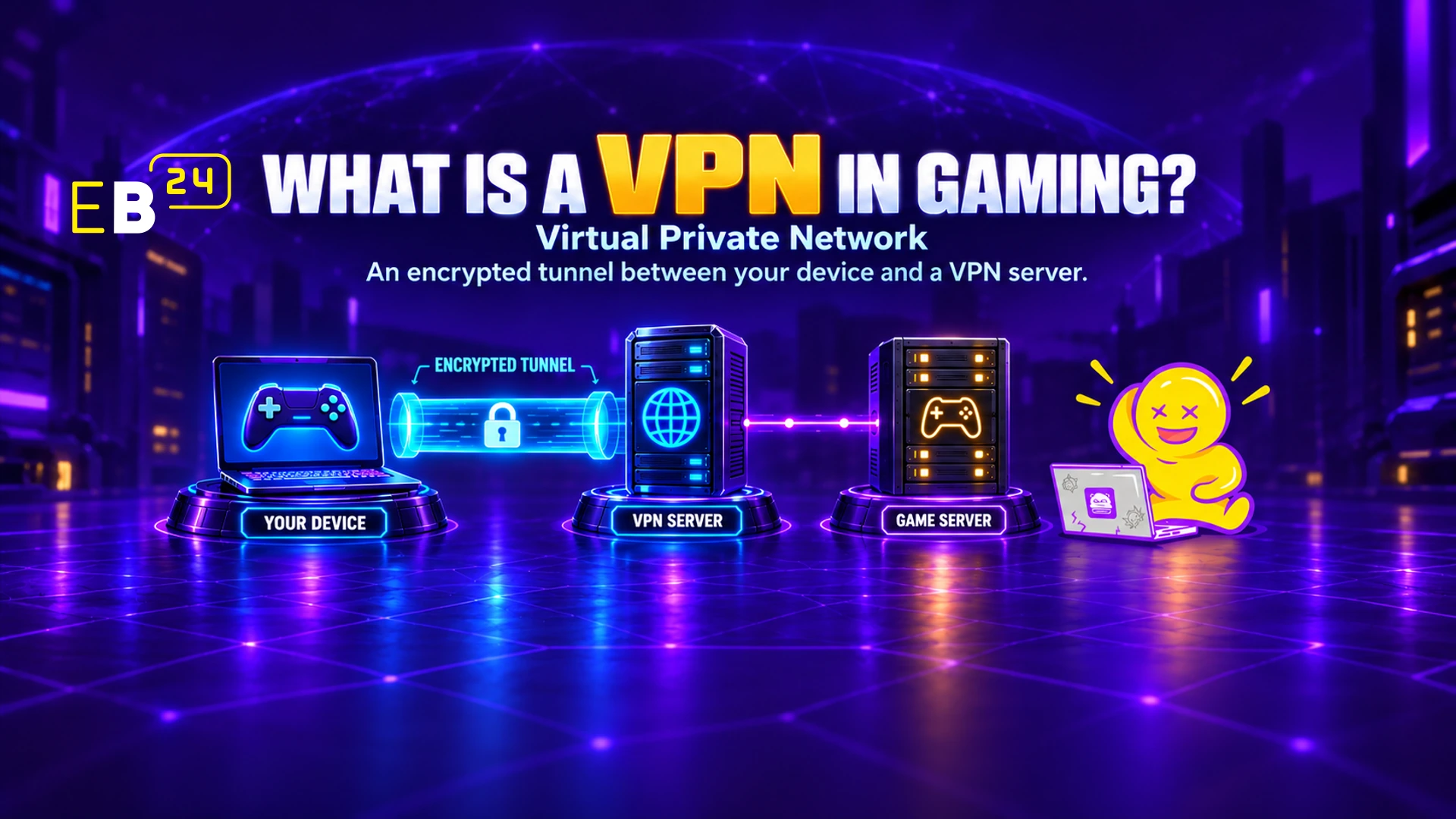
A VPN, or Virtual Private Network, routes your connection through a server in another location before it reaches the game. In gaming that means you can play on servers in other regions, reach rewards and events tied to specific countries, and sometimes get a cleaner route to the server than your own ISP provides.
Quick facts | |
|---|---|
Stands for | Virtual Private Network |
What it changes | The route and apparent location of your connection |
Main gaming uses | Other regions, regional rewards, routing, DDoS protection |
Effect on ping | Can lower it or raise it depending on the route |
Works best for | Long distance connections with poor ISP routing |
Works worst for | Connections that are already direct and local |
Playing on other regions
This is the most common reason players use one. League of Legends, Valorant, CS2 and most MMORPGs run separate regional servers, and a VPN lets you connect to the one you want rather than the one your location defaults to.
The practical reasons vary. Playing with friends who live elsewhere. Queueing on a region where your main is still in the meta. Getting into a server at a time of day when your home region is dead. Testing a ladder in a region with a different skill distribution.
For an account you intend to keep playing long term, a permanent region transfer is the cleaner option, since it moves the account properly rather than routing around the problem every session.
Regional rewards and events
Developers and partners frequently run things that only exist in certain places. Twitch drops limited to specific broadcasts, event skins tied to a regional client, free rotations and promotions that never reach every server, beta access that opens in one region weeks before the others.
A VPN gets you in front of those while they are live, which is usually the whole window.
Ping and routing
The common assumption is that a VPN always adds latency. Often it does, but not always.
Your ISP picks the route to the game server, and that route is frequently inefficient, especially on long distance connections or during peak congestion. A VPN with a well placed endpoint can take a shorter path than the one your ISP chose.
Situation | Likely effect on ping |
|---|---|
Local server, direct route | Higher ping, no benefit |
Distant server, poor ISP routing | Lower ping, sometimes significantly |
Peak hour congestion on your ISP | Lower ping, more stable |
Any route through a far VPN endpoint | Higher ping |
The honest version is that it is worth testing rather than assuming. If your route is already clean, a VPN will not improve it.
The other uses
ISP throttling. Some providers shape gaming traffic during peak hours. Encrypted traffic is harder to single out.
DDoS protection. Relevant for streamers and high ranked players whose IP has been exposed. The VPN endpoint absorbs the traffic instead of your home connection.
Restricted networks. University, office and hotel networks routinely block game ports. A VPN usually gets around it.
If you want an account on another region
Rather than routing every session, our marketplace carries accounts across EUW, EUNE, NA, KR, TR and other servers, ready to play on the region you actually want.
Frequently Asked Questions
Does a VPN lower ping in games?
It depends. On distant or badly routed connections it often helps. On a clean local route it will add latency.
Can you play on another region's servers with a VPN?
Yes. That is the most common gaming use, and it works across most major titles with regional server structures.
Does a VPN slow down your connection?
It depends on the endpoint. A nearby, well provisioned server costs very little speed, while a distant one costs a lot.
Enrichissez vos connaissances avec ces définitions de Général associées :
Définitions Général