




What is KAST in Valorant?
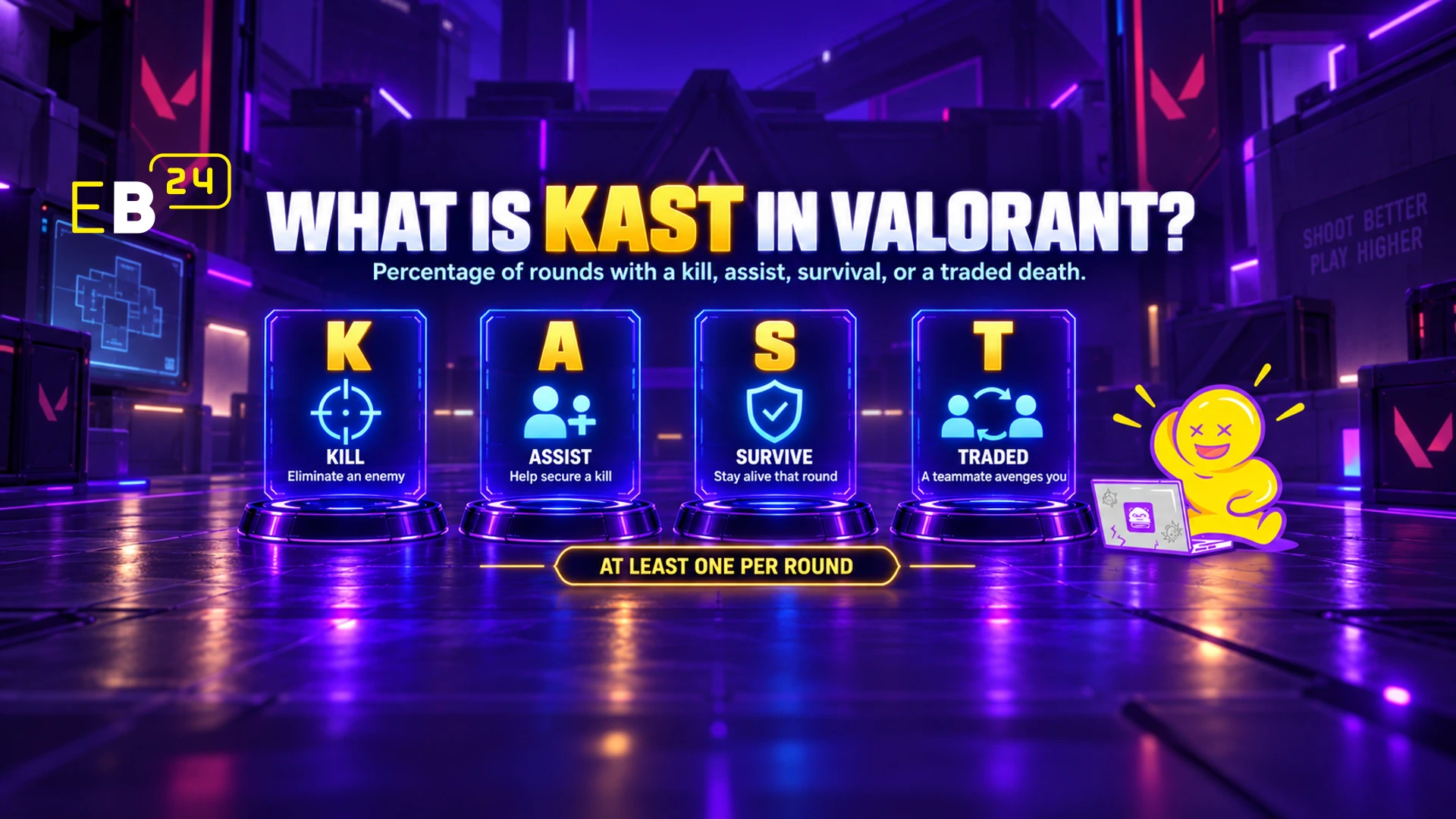
KAST stands for Kill, Assist, Survived, Traded. It measures the percentage of rounds where you did at least one of those four things, which makes it the clearest single number for how often you actually contributed to a round rather than how many kills you collected.
Quick facts | |
|---|---|
Stands for | Kill, Assist, Survived, Traded |
Measured as | Percentage of rounds, not a raw count |
Average | Around 70 percent |
Good | 72 to 78 percent |
Elite | 80 percent and above |
Best for | Supports, controllers and sentinels |
What counts toward your KAST
A round counts in your favour if any one of these happened:
Kill. You got a frag.
Assist. You damaged or utility-assisted someone who died.
Survived. You lived to the end of the round, whether you did anything or not.
Traded. You died, but a teammate killed your killer shortly afterwards.
Only one of the four is needed, and that is the entire design. A round where you died first, did no damage and nobody traded you is the only outcome that counts against you.
What a good KAST actually is
KAST | What it means |
|---|---|
Below 65% | You are dying early and uselessly too often |
65 to 70% | Below average, usually an entry or positioning problem |
70 to 75% | Solid. Most ranked players sit here |
75 to 80% | Strong, consistent round impact |
Above 80% | Elite, typically pro level consistency |
The figure varies by role. Controllers and sentinels naturally run higher because surviving and assisting come built into how they play. Duelists entering sites run lower, and a duelist at 72 percent is doing a harder job than a sentinel at 78.
Why KAST beats KDA
KDA rewards frags. KAST rewards presence.
A player who goes 25/18 on a duelist can still be losing rounds constantly, because twelve of those kills arrived after the round was already decided. A player on 6/9 with 80 percent KAST was in every round that mattered, trading, assisting and surviving to the retake.
This is why KAST is the stat coaches reach for first. It identifies the player who dies to the first contact every round, which no kill-based stat will ever show you.
Raising it
Almost every low KAST is a positioning problem rather than an aim problem. Dying first, entering without utility support, and holding angles with no trade partner nearby are the three biggest causes.
If you want it diagnosed properly rather than guessed at, our Valorant boosting and coaching services cover exactly this kind of round-by-round habit, and our ACS guide explains how the two stats fit together.
Frequently Asked Questions
Is 70 percent KAST good in Valorant?
Yes, roughly average to solid. Anything above 75 is genuinely strong.
Does surviving a round without doing anything count for KAST?
Yes. Simply being alive at the end of the round counts, which is the most criticised part of the stat.
Is KAST more important than ACS?
It depends. KAST shows consistency, ACS shows impact. Reading them together tells you far more than either alone.
Enrichissez vos connaissances avec ces définitions de Valorant associées :
Définitions Valorant